
Leaving progressive glasses behind: switching to contact lenses
More and more progressive glasses wearers in Barcelona are considering multifocal contact lenses as a full or partial alternative. This is what the transition looks like and what you can expect from it.
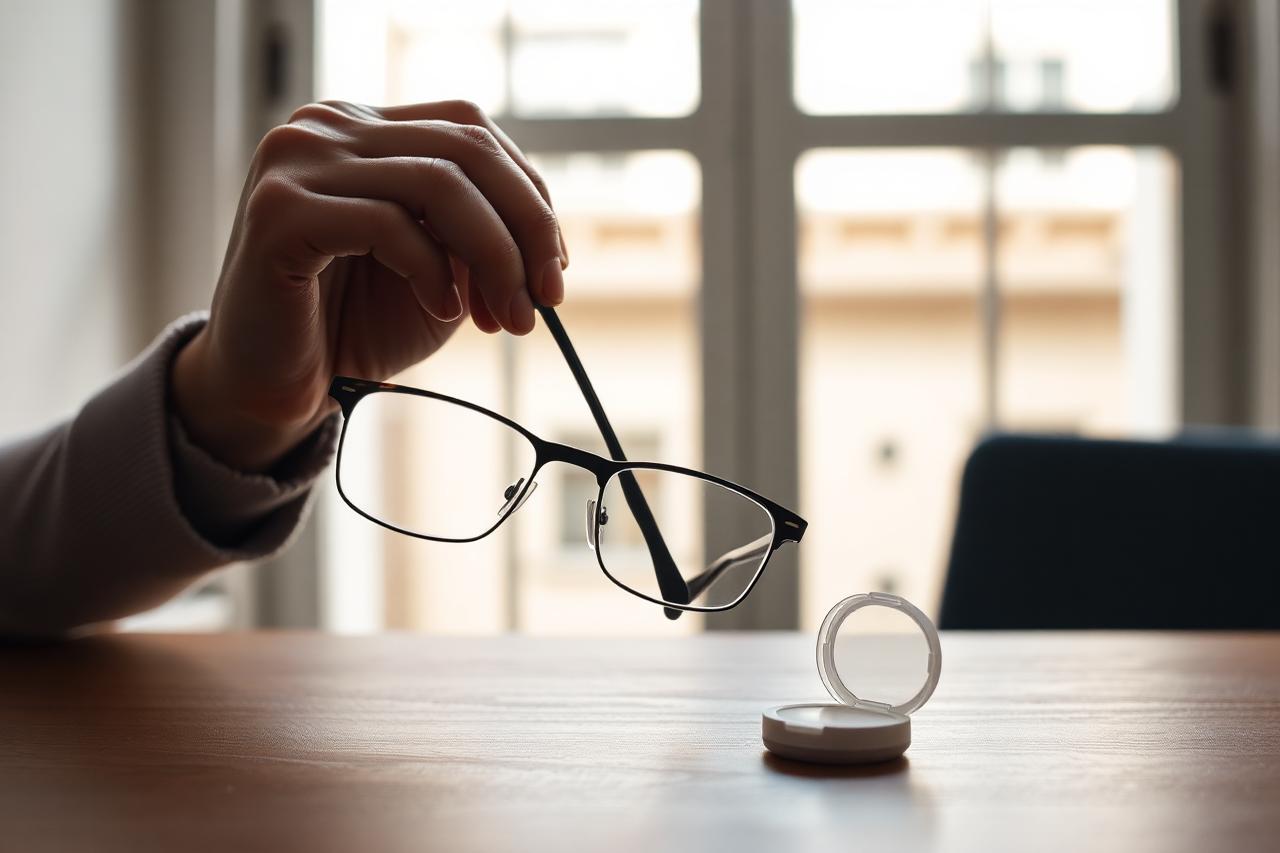
Why so many people consider the switch
Progressive glasses work very well, but they do not fit everything: they fog up, bother you in the rain, limit some sports, leave marks on your nose after hours of wear and, for many people, are a constant reminder of age.
Multifocal contact lenses address precisely those points: a full field of vision without a frame, freedom of movement and a glasses-free look whenever you want it.
Differences in visual experience
With progressive glasses you look through different zones of the lens by moving your eyes or head: up for distance, down for near. With a multifocal contact lens, the different powers reach the retina at the same time and the brain selects the useful image (simultaneous vision).
In practice, this means the lens gives you freedom of gaze in every direction, but the maximum sharpness at a specific distance may not be identical to that of your well-prescribed glasses, especially at first.
How the transition works
Assessment and lens selection
Your current glasses prescription, eye health and tear film are reviewed, and the multifocal contact lens with the best chance of success for your case is selected.
Trial and neuroadaptation
During the first days or weeks the brain learns to interpret simultaneous vision. It is common to need some adjustment of power or design.
Follow-up
Check-ups confirm the result. Many people end up combining: lenses for everyday life and glasses at home or as a backup.
Realistic expectations
The key is a professional fitting and giving the process the time it needs. If after the adjustments the result does not convince you, you can always go back to your glasses without any problem.
- Most wearers achieve very satisfactory functional vision at all distances.
- Differences compared to glasses may be noticeable during the first days, especially for demanding near tasks.
- There is no need to give up glasses: many people alternate them depending on the situation.
- The result improves with adjustments; the first trial lens is not always the final one.
Can I keep my progressive glasses?
Of course. In fact, it is advisable: your glasses remain your backup option and many people wear them at home or in the evening.
Does my glasses prescription work for contact lenses?
It serves as a starting point, but the contact lens prescription is calculated specifically and may differ. That is why a complete contactological assessment is required.
What if I already know how to handle contact lenses?
If you have worn contact lenses before, handling will not be an obstacle and the process focuses on the optical side: choosing the design and adjusting the near and distance powers.
Want to know if multifocal contact lenses suit you?
Book a personalised consultation with our contact lens specialists to discuss your options and clear up any doubts.
Book a personalised consultationContent reviewed by Elena Sentís — Optometrist · Reg. no. 18568 · Technical Director at Looptica